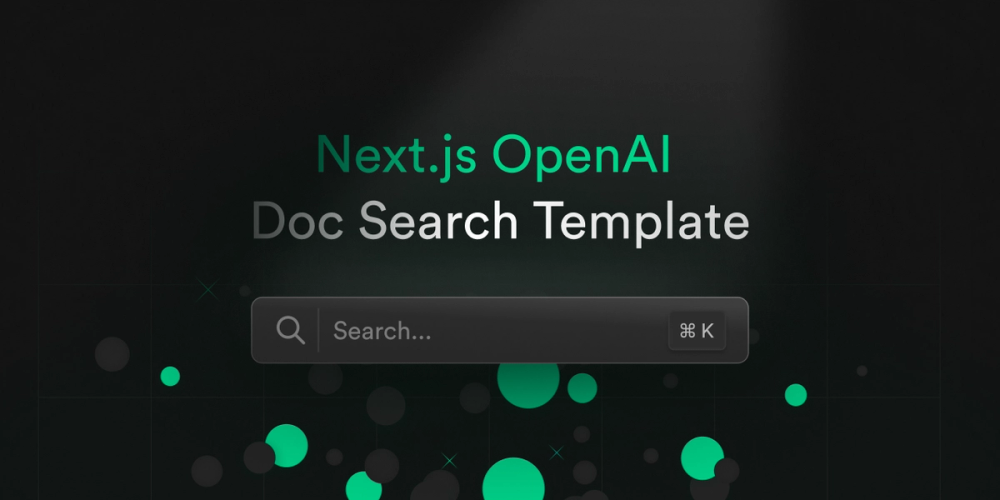
This starter project provides a robust template for building a custom ChatGPT-style documentation search application using Next.js, OpenAI, and Supabase. It leverages advanced AI capabilities to offer intelligent search functionality over your .mdx documentation files.Key features include: Intelligent Document Processing: Automatically processes .mdx files from your pages directory, chunking them into manageable sections for efficient indexing. OpenAI Embeddings: Utilizes OpenAI's API to create vector embeddings for each document section, capturing semantic meaning. Supabase & pgvector: Stores these high-dimensional embeddings in a PostgreSQL database, enhanced with the pgvector extension, enabling fast and accurate vector similarity searches. Real-time Search: At runtime, user queries are converted into embeddings, which are then used to perform a vector similarity search against your stored document embeddings. This retrieves the most relevant content sections. Contextual AI Responses: The retrieved relevant document content is injected into OpenAI GPT-3 text completion prompts, allowing the AI to generate highly contextual and accurate answers. Streamed Responses: Responses from the OpenAI API are streamed directly to the client, providing a dynamic and responsive user experience. The project outlines a clear workflow: Build Time: Documentation files are pre-processed, and their embeddings are generated and stored in Supabase's PostgreSQL database. A checksum mechanism ensures embeddings are only regenerated when files change. Runtime: User queries trigger an Edge Function that generates a query embedding, performs a vector similarity search in the database, and then uses the retrieved context to formulate a completion request to OpenAI, streaming the AI's response back to the user. This template is ideal for developers looking to quickly implement an AI-powered search solution for their documentation, knowledge bases, or any collection of text-based content, offering a powerful way to enhance user interaction and information retrieval.

Next.js OpenAI Doc Search Starter
Template for building your own custom ChatGPT style doc search powered by Next.js, OpenAI, and Supabase.
Introduction
Information
- Publisher
- Websitegithub.com
- Published date2025/11/16
Categories
Sponsored
AIBoilerplateAdmin dashboard
ShipAny
ShipAny is a development framework for building AI SaaS, with rich built-in functional modules and business components, helping you quickly launch your website.