
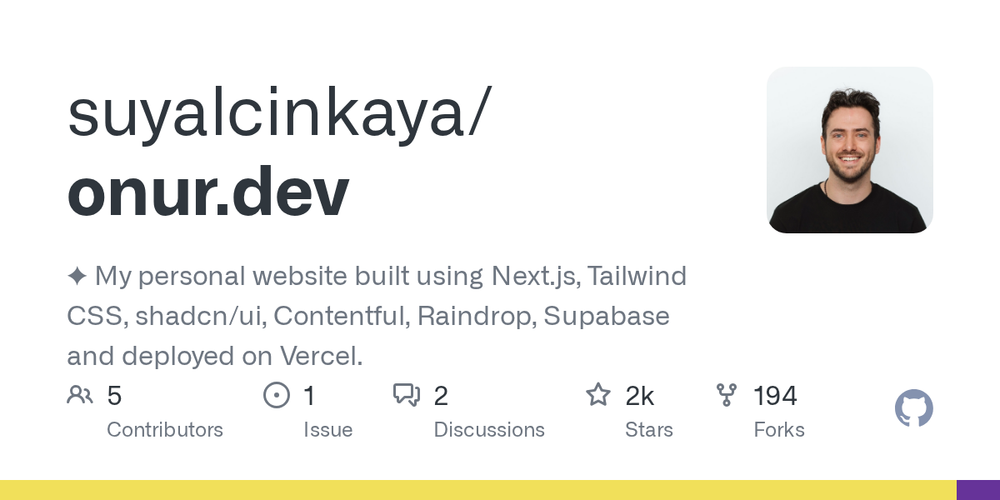
The website onur.dev is a personal platform that has undergone several technological transformations, evolving from a basic static HTML page to a sophisticated application built with modern web technologies. Initially, it started as a simple static site, then progressed through Create React App and GatsbyJS, before settling on a robust stack combining Next.js, Chakra UI, and MDX. The current iteration leverages Next.js, Tailwind CSS, and Contentful for a highly performant and visually appealing experience.
This platform is designed to be an app-like web experience, offering various sections to showcase the author's digital presence. Key features include:
- Writings: A dedicated section for blog posts and articles, powered by Contentful for content management.
- Journey: A page detailing the author's professional and personal journey.
- Bookmarks: A curated collection of bookmarks, integrated with Raindrop.io, and accessible via static pre-rendered pages and an XML feed.
- Stack: A page outlining the technologies used in the project.
- Workspace: A section showcasing the author's development environment and tools.
- API Routes: Backend functionalities exposed through
/apiendpoints.
The technical stack is modern and robust, including:
- Next.js: A React framework for production, enabling server-side rendering (SSR) and static site generation (SSG).
- Tailwind CSS: A utility-first CSS framework for rapidly building custom designs.
- shadcn/ui: A collection of re-usable components built with Radix UI and Tailwind CSS.
- Contentful: A headless CMS used for managing static content like writings and other pages.
- Raindrop.io: An all-in-one bookmark manager, integrated for the bookmarks section.
- Supabase: An open-source Firebase alternative, likely used for database or authentication needs.
- Vercel: The platform for deployment, known for its seamless integration with Next.js.
To run the project locally, users can clone the GitHub repository, navigate into the directory, install dependencies using bun i, and start the development server with bun dev. A .env file, based on .env.example, is required for environment variables. The project operates under a simple, kind license: users are encouraged to take inspiration, avoid direct copying, and credit the author. This personal website serves as a comprehensive digital hub, reflecting the author's technical skills and interests.